


Blog Post: Exploring Autism Within Music
- mdpmicahdominicpar
- Jul 25
- 2 min read
Imagine for a moment a world in which you know everything about everyone else and everyone knows everything about you. What would this world be like? I personally believe that this world may lack quite a lot of communication.
Now imagine a world where you are aware that other people have different points of view but they are different to how you see the world. The worlds just described in the above sentences can often be the way in which people with Autism see the world.
I have had the privilege to work with many students who have had a diagnosis of Autism and I wanted to share a few thoughts with you all.
Autism which is often called ASD (Autism Spectrum Disorder) impacts the way that people experience the world around them.
Key indicators of Autism are as follows:
. Ritualistic or repetitive behaviours.
. Difficulty expressing feelings and emotions.
. Sensitivity to light, sound, touch, taste or smell.
. Dislikes changes to routine.
. Difficulty making friends and socialising.
. Difficulty in interpreting other people's feelings and emotions.
. Difficulty in listening, concentrating and understanding.
. Can often take what is said in a literal sense.
The world can be quite a confusing place and people with Autism can struggle even more to make sense of the world around them.
You may be familiar with the terms Asperger's Syndrome, Pervasive Developmental Disorder, Childhood Disintegrative Disorder and Rett Syndrome. This terminology is no longer used (although if you have an older diagnosis you may still be using this older teminology). Today we see all learning needs as being on a spectrum which allows professionals to focus on the needs of the individual rather than a label.
Autism is often accompanied by other learning difficulties or health conditions which can include Oppositional Defiant Disorder, Attention Deficit Hyperactivity Disorder, Obsessive Complusive Disorder, Sensory Processing Disorder, Dyspraxia and Dyslexia.
As mentioned previous we now look at Autism on a spectrum which looks a little bit like the attached picture below:
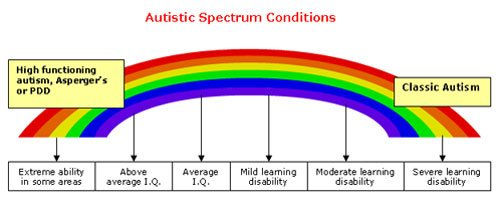
The reality is that Autism looks a little more like the attached picture below:

This leads me on to the question of how we can best support our students who have a diagnosis of Autism especially when related to music, I have included some thoughts below:
1. Build a positive professional relationship with your student - The world can often be a confusing place for a person with autism and new people can present a source of anxiety for a person with autism.
2. Build a positive routine.
3. Consider the changes that can be made to the learning environment which will help support the student.
4. Communicate in a way that is clear and understandable.
5. Keep thing simple.
6. Work alongside parents and carers to establish an all round support system.
7. Build your own resilience and professional practice.
I wanted to finish this short blog post by saying that no one size fits all approach can be taken as everyone is an individual and certain techniques may only work once or not at all and by having an evolutionary attitude to delivery and support can really be of benefit to the student.


Comments